Tuesday, April 26, 2016

Sunday in Copacabana

On Sunday, April 24th, after breakfast in our room, we decided to walk up to the lookout point on the hill above our hotel. As we climbed up the steep street to the beginning of the trail, we realized that there was a pilgrimage route that led up the hill from a little church at the bottom. The rough cobblestone trail is very steep and there are stations of the cross every 100 metres or so. There were quite a few groups or families making their way up the trail and stopping to pray at every stone cross along the way. Unfortunately, all of the crosses have graffiti spray painted on them and there is lots of litter along the trail. Nobody seems to notice.
Near the top, we came to a little resting place where there were some vendors and people enjoying a snack. Men were drinking beer at 10:30 in the morning. We decided we'd climbed high enough and walked along a little trail out to a quiet place to sit and look out over the lake. Again, there were heaps of plastic bottles and broken glass along the trail. It's such a shame that there's so much garbage and vandalism in such a beautiful place.
Eventually, we picked our way back down the cobblestone path to the little church, fortunately without breaking an ankle. We found our way through the narrow streets to the big cathedral and went inside. Construction of the Santo Domingo cathedral in Copacabana was begun in the early 1600's and finished in the early 1800's. It is dedicated to the Virgin Mary. At some point, a descendant of the Incan emperors had carved a wooden statue of Mary, which was placed above the altar. Shortly thereafter, healing miracles were attributed to prayer before this statue. Eventually the Pope recognized this cathedral and statue as an unusually holy place. So, just as the pre-Hispanic indigenous people had done, Bolivians still make pilgrimages to Copacabana. There seems to be a mixture of Christian and indigenous spirituality.
Mass was in progress. We sat for a few minutes and then went back out in the sun. There we finally realized what the decorated cars on the street in front of the cathedral were all about. There were about 20 or more cars lined up. As cars pulled up to the end of the line, the drivers stopped, opened the hood and waited. A priest greeted the drivers and took payment first, of course. Then the priest dipped into his plastic pail of holy water, presumably, and sprinkled water on the car engine and all over the car. Sometimes he sprinkled some on the hands of the drivers. Many of the cars appeared to be new and were getting their inaugural blessing.
A little further along the line, the drivers got bags of flower petals and sprinkled them all over the cars. There was a flower vendor selling bouquets and people decorating the cars. Finally, right in front of the main gate to the cathedral, a man opened big bottles of beer, shook them and walked around the car spraying it with beer. Everyone was happy that the car was now blessed so they could go out onto the narrow cobblestone or dirt roads and drive like maniacs in total safety.
In Southeast Asia, we've seen extremely elaborate Buddhist temples and statues and all the ways that the monks have found to gather money from very poor people. In Budapest, we could have paid $2 to light up the glass case containing the mummified right hand of some Saint. However, making money by blessing cars right in front of the cathedral while Mass was in progress was a new experience. It didn't seem to have a hell of a lot to do with Jesus. We were reminded of the classic story of the wrath of Jesus about the moneychangers in the temple. We just shook our heads.
We walked back through the market, which was busier than ever on Sunday, and took a photo of a big bag of popped corn. There are all sorts of varieties of corn and potatoes on sale as well as the usual meat hanging out in the open. Refrigeration is minimal here.
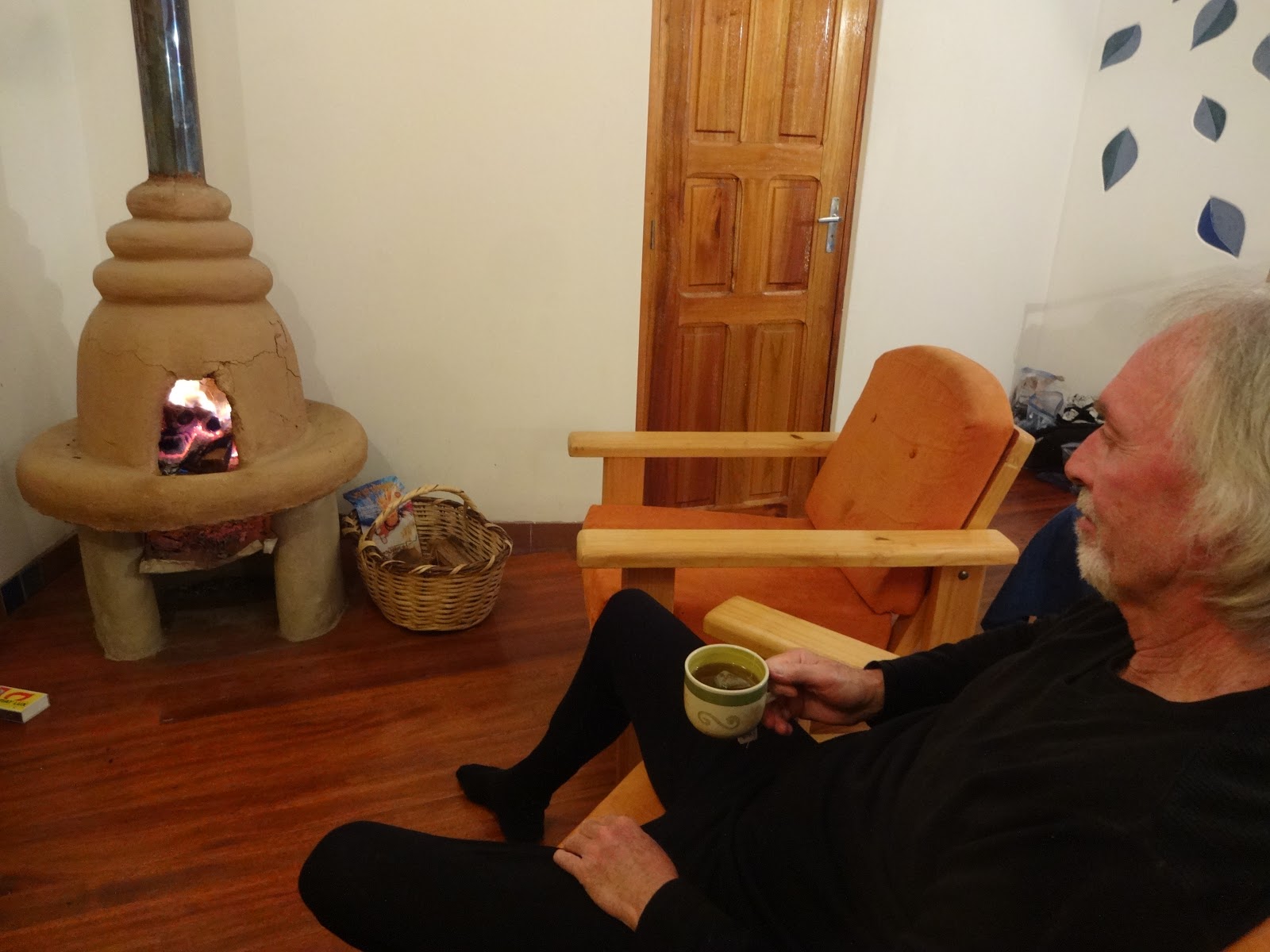
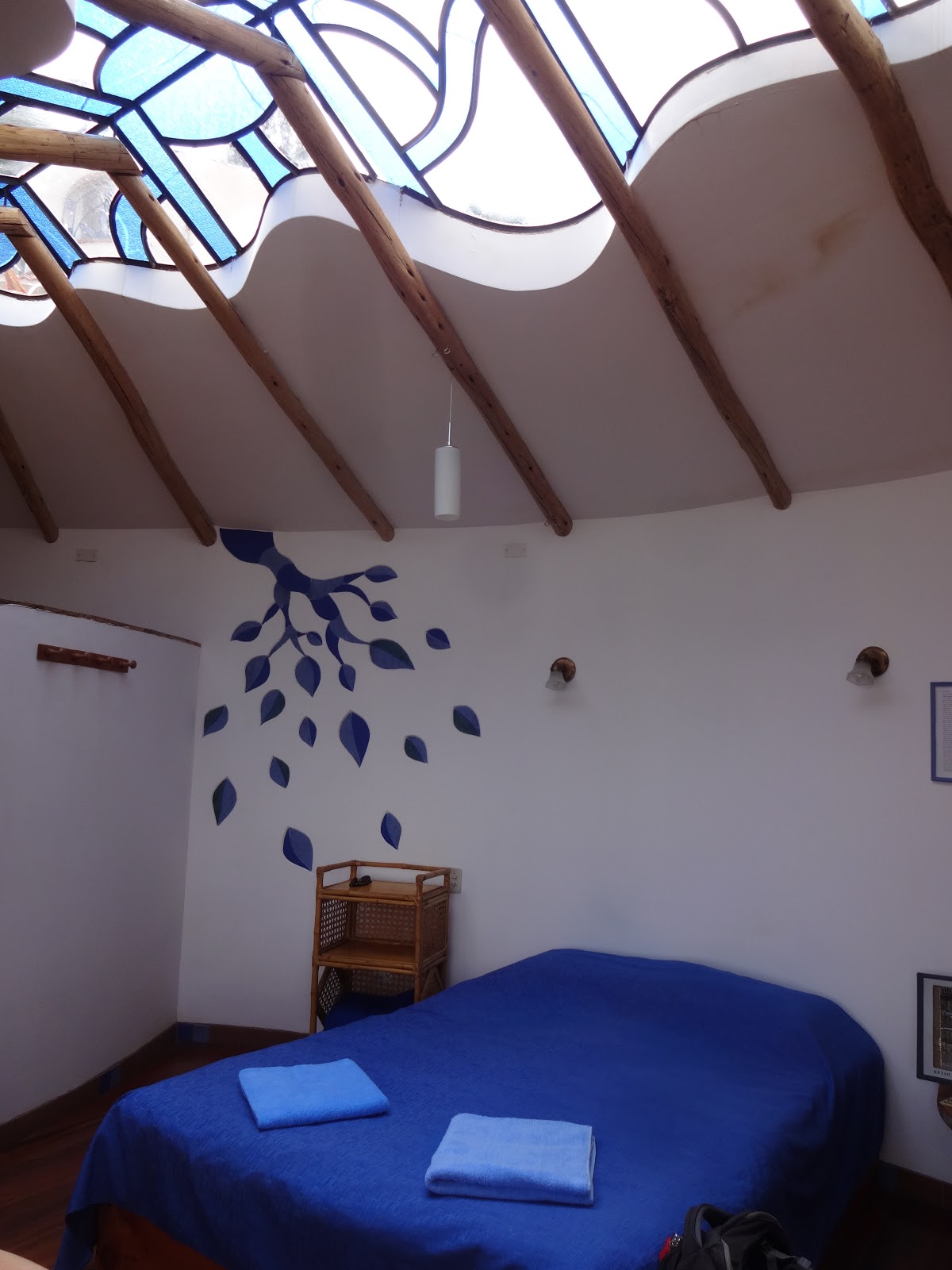
Back at our hotel, we enjoyed happy hour on our lawn chairs in the sun. In the evening, we ate 2 different trout dishes in our hotel restaurant. Excellent meal. We made a fire in our little wood stove, got comfortable in our merino wool underwear and even stayed up until 9:30 as the moon rose over the lake and shined through our big stained glass skylight. Great day.


Copacabana Beach

On Saturday, April 23rd, after breakfast in our room, we decided to walk along the waterfront. It was a beautiful, sunny day. The previous afternoon, we had checked out boat trips to the Isla del Sol and had decided against it. The boat trips leave at 8:30 am and take 2 hours to get to the island. Most of the trips allow about 3 1/2 hours of hiking and sightseeing before there's a 2 hour  trip in the enclosed boat back to Copacabana. We didn't want to spend 4 hours in an enclosed boat cabin.
According to indigenous people's beliefs, the island is the birthplace of the sun while another smaller nearby island is the birthplace of the moon. The indigenous people also believed in "Pacha Mama" or Mother Earth and in various other spirits of the natural world. The Incas believed that the first Incan Emperor rose from the earth on the Isla del Sol. In those days, the village of Copacabana was a resting place before making a pilgrimage to the island.
Copacabana is still a religious pilgrimage destination but it is also a weekend tourist destination for people from La Paz. Along the lakeshore there are lots of food vendors, paddle boat rentals, boat tours and even a few personal watercraft rentals. The beach is stony and the water is cold but it's a beautiful, big lake. Unfortunately, at a couple of places there is raw sewage pouring into the lake. There's also lots of litter. Environmental awareness seems even lower in Peru and Bolivia than it is in Ecuador.
We walked along the shore out of town until we felt we'd gone far enough. We stopped and sat on a rock for a long time for a rest, chew of coca leaves and drink of water. After we walked back to town, we went up the main tourist street which eventually led to the cathedral and a nice square. Near there, we walked through the daily market and picked up a few more eggs and buns for breakfast. The market stalls and shops are typical of what we've seen elsewhere except that they're all run by short, full figured ladies in traditional big skirts, aprons, long braids and various bowler hats or fedoras. Buns in the shops are just piled on the floor in cardboard boxes. How many times they've been handled is a question. With luck, we get a plastic bag to put them in.
We walked back up the hill to our room and sat out in the sun on our lawn chairs for awhile. In the middle of the day it's great to feel warm in the sun while looking out over the beautiful lake. Eventually, we went back down to the main tourist street for an early dinner of pizza. Every town has roast chicken and pizza restaurants. People like to share a pizza as a social outing. Plus, right in the middle of the restaurants is often a wood-fired pizza oven, which provides a little warmth. As soon as the sun starts to go down, it's cold here. The waiters in the restaurants usually wear coats and hats, as do all the patrons. Although its not nearly as cold as it can be at home, buildings and homes are uncomfortably cool.
On our first night here, I couldn't get our little clay wood stove going because the wood and little bit of kindling that was left for me was too damp. On the second night, I made sure the fire got started so our room was much warmer than it had been. However, we still need merino wool underwear, a hot water bottle and lots of blankets.


Puno, Peru to Copacabana, Bolivia

On Friday, April 22nd, we checked out of the San Antonio Suites and caught a cab (5 soles or $2 CA) to the bus station. After checking in at our bus company's counter we did the usual last washroom stop and paid the departure tax.
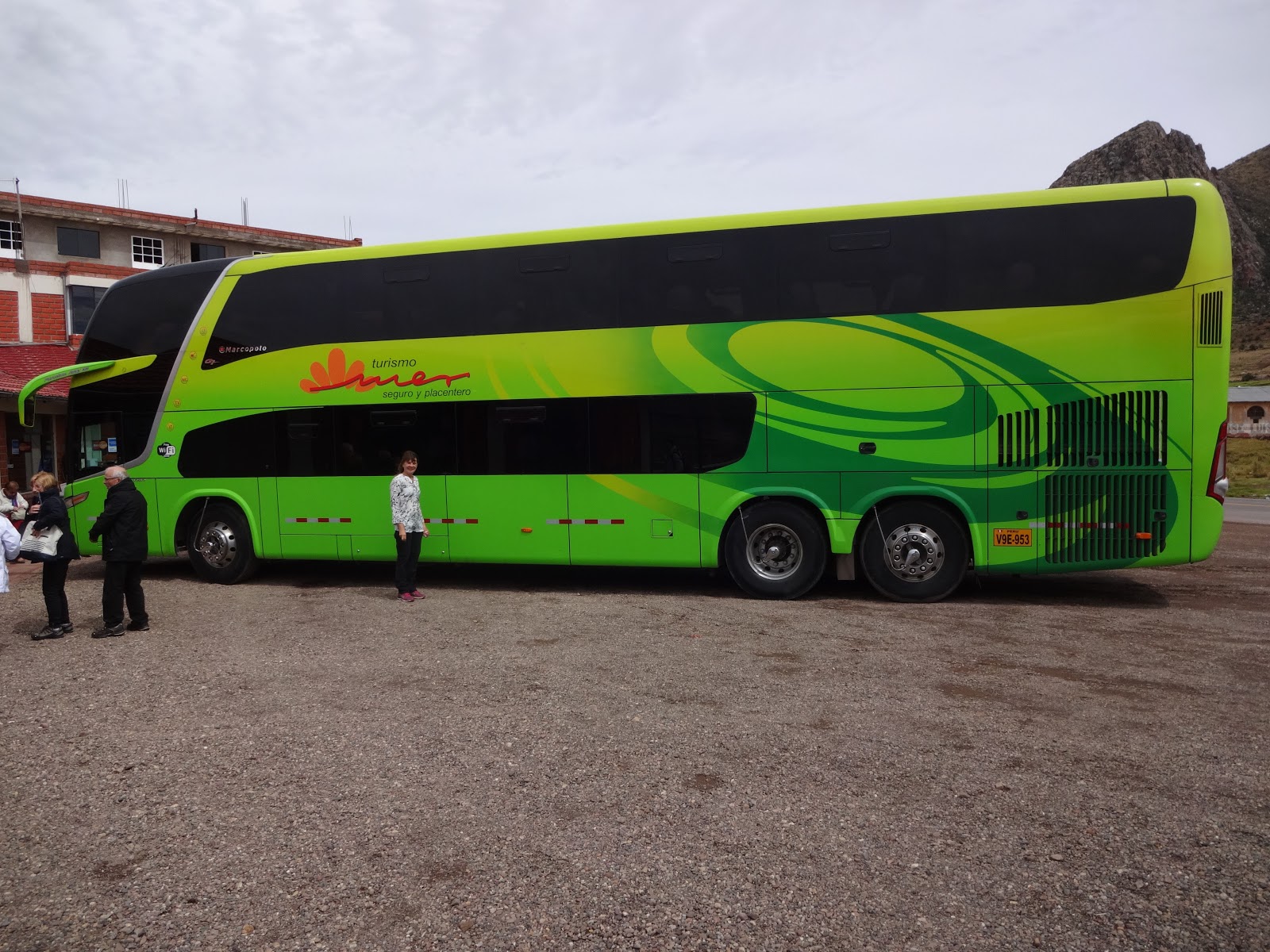
Our bus looked good from the outside and was fairly comfortable but it seemed like it hadn't been thoroughly cleaned in about 10 years. It smelled like dirty socks. Nevertheless, that was the way it was for the next 4 hours.
We skirted the southwest shore of Lake Titicaca through a number of small, poor farming villages. After almost 3 hours, we arrived at the border with Bolivia. Everyone got off the bus, exchanged some Peruvian soles for Bolivian Bolivianos and walked into the little Peru immigration office to exit the country. One young German guy had lost his Andean Immigration Card, the Peruvian visa paper, so he was detained while the rest of us were checked and then walked about 100 metres to the Bolivian side of the border. We carried our day packs while our big packs were still under the bus, which would cross the border to pick us up later. No-one checked anything we were carrying.
At the Bolivian office, we filled out another form and were soon admitted to the country. Two or three Asian people, from some country unkown to us, didn't have the proper visas and were detained at least 1/2 hour. I expect that money was the solution. Eventually the young German and the Asians were admitted to Bolivia. We all re-boarded the bus and were on our way.
If we had thought that the rest of Bolivia looked like the border crossing, we might have turned around and gone back. Everything at the border was very shabby and there was lots of litter. Not that nice.
In another 1/2 hour we reached Copacabana, a small town on the south shore of Lake Titicaca. We could see our hotel, La Cupula, up on the hillside about a 5 minute walk from the centre of town. Carrying our packs uphill at this altitude required a few rest stops but eventually we checked in. Our little suite has kitchen facilities, a small molded clay wood stove, its own lawn with 2 chairs and a big window overlooking the lake and town. Very beautiful.


Monday, April 25, 2016

Uros Reed Island Tour

On Thursday, April 21st, a van came to our hotel at 8:50 and picked us up for a floating island tour. We had arranged it through our hotel for 20 soles each (about $8). At the port, about 15 tourists got on a small tour boat with enclosed cabin. For about 15 minutes we boated across the bay of Puno. Then we entered a narrow channel through the reeds. At one point, we stopped and the tour guide paid an entrance fee for the boat.
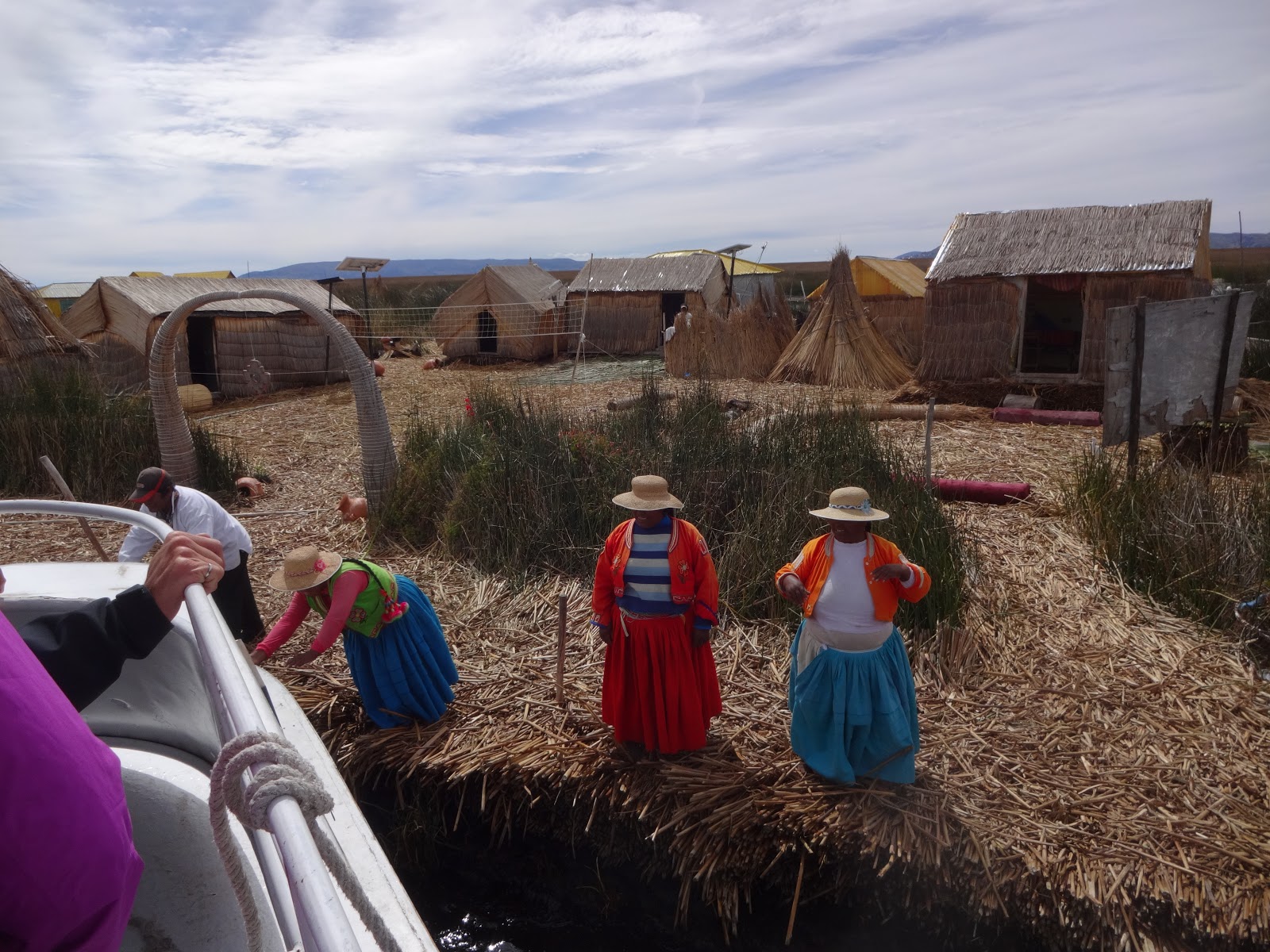
The channel widened a bit and soon we were in the middle of about 80 or 90 floating reed islands. The Uros people moved out here centuries ago to avoid conflict on the mainland. The totura reeds that grow here are very buoyant when they are dried. The people weave mats of reeds among the growing reeds to create an island. Every year in rainy season, the level of Lake Titicaca rises about 2 metres. When that happens, the reeds pull up and the created island floats. It's a constant battle to add layers of reeds to the top as the bottom layers rot. The core of the totura reed is also used as food.
We arrived at a floating island and were greeted by the half dozen people who lived there. Tourism is their main source of income now so they were very friendly. All the ladies wore traditional dresses and hats. This was not unusual because many of the older women in Puno and area dress like that.
We got an explanation of how to build a floating island, a tour of the homes and cooking facilities and, eventually, a ride to another island on a reed boat paddled by two of the ladies.
It was all interesting and fun on such a beautiful sunny day. It may have been the most touristy thing we've ever done but we enjoyed it anyway.


Puno, Peru

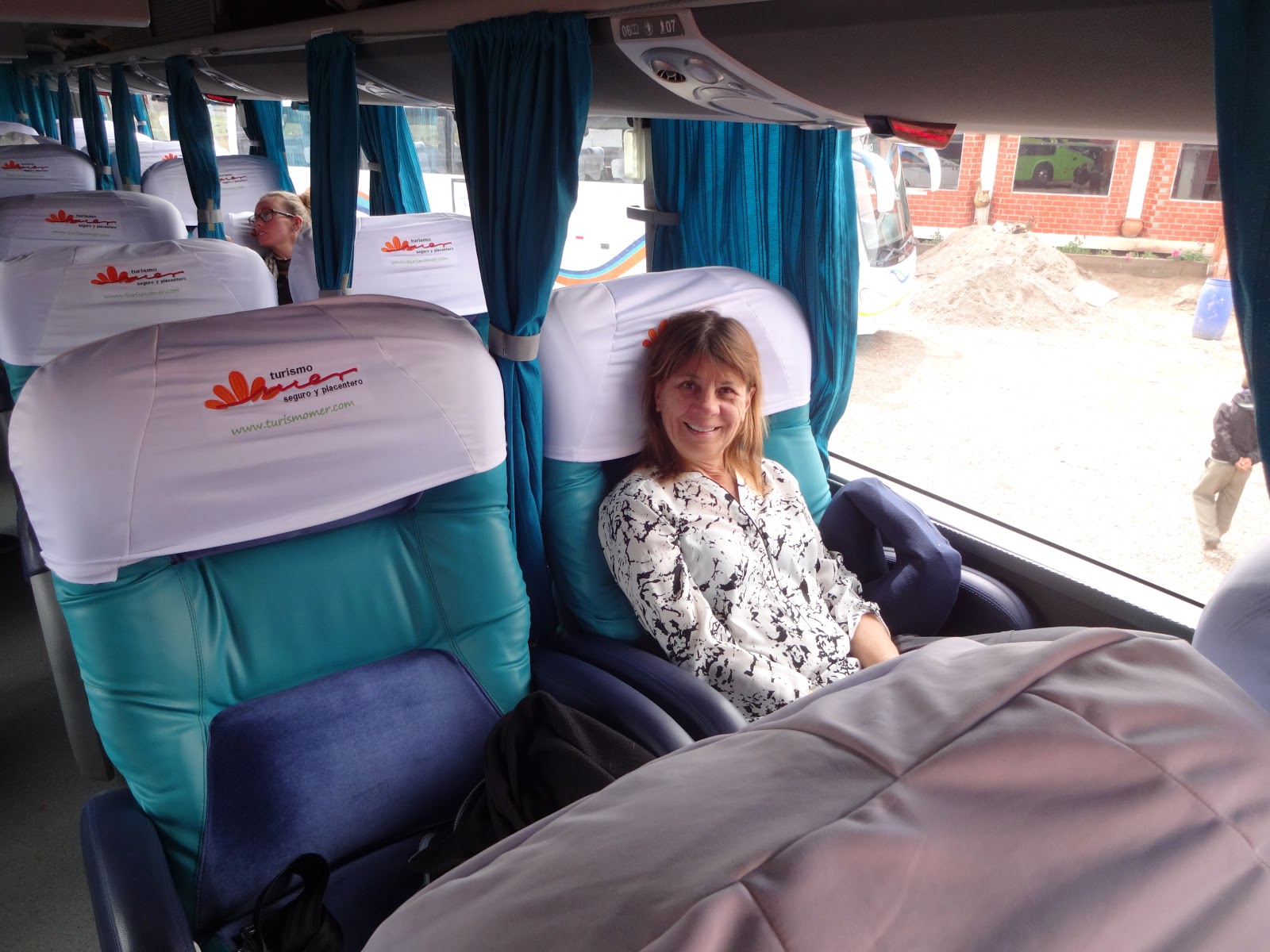
On Wednesday, April 20th, we got up early, had a quick breakfast and checked out of our hotel in Cusco. We only had to walk a little way down the streets before a taxi came along and for 5 soles ($2 CA), took us to the "terminal terrestre" or bus station in about 15 minutes. We checked in at the bus company counter, paid our 2.60 soles departure tax, had a last washroom visit and boarded our bus. This was the fanciest bus we had ever been on. Very comfortable.
From 8:30 am until 3:00 pm, we traveled through the high valleys of the Andes toward Puno on the western shore of Lake Titicaca. The natural scenery was very pretty but most of the little villages looked poor.
About an hour before we got to Puno, we passed through the small city of Juliaca. One of the few places we've seen a lot of mud and dust on the same day. Every surface appeared to be coated with a layer of grime. "Shithole" is the only appropriate description. We were happy to be just passing through.
At the Puno bus terminal, a taxi driver sent by our hotel, the San Antonio Suites, greeted us with a sign with our name on it. It was a nice complimentary service. Puno is a small city so it only took about 5 minutes to get to the hotel, near the town square. The hotel was old and plain but clean and secure. We checked in and climbed the stairs to the 3rd floor. Just doing that caused us to be out of breath. The elevation at Puno is 3,830 metres or 12,565 feet above sea level. Here, the sun warms the air up to about 15C during the day but the nights seem to be just above freezing.
All of the hotels we have stayed in are masonry construction with single glazed windows, no insulation and no heat. The walls and roof keep the rain and wind out but that's about it. All surfaces are cold, especially the ceramic tile in the bathrooms. We were able to get a plug-in electric heater for our room on the second night but it only helped slightly. We've taken to wearing our merino wool long underwear, socks and a sweater or fleece to bed, even though there are lots of covers. We always have to wear flip flops on our feet to go to the bathroom.
The other problem with the elevation is getting used to less oxygen. Being out of breath after slight exertion is one thing but worse is waking up out of breath in the middle of the night. Anita experienced this last year in Quito and I've been having trouble with it this year. Most nights I have to sit up in bed for a couple of hours in the middle of the night so I can breathe. It makes for a long night.
Anyway, after getting organized we found our way to the main square and to a pedestrian street where we bought bus tickets to Copacabana, Bolivia for Friday. After checking our guidebook, we decided on a 2nd floor restaurant where we got a table overlooking the main plaza. We just happened to sit near a couple who were retired optometrists from Houston and were staying at the same hotel as us. They were kind enough to confirm the diagnosis that Anita had gotten from the opthalmologist in Arequipa. The flashing lights in her eyes should be checked when we get home but are likely not a serious problem so there's no need for immediate worry.
After talking with them through dinner, we all went back to our hotel breakfast room for a cup of tea and continued our conversation about various places we had traveled. They also live right near the Houston Space Administration where our son Josh had done some filming for his latest movie. Everyone in their neighbourhood works there.  And once again, the American travelers we meet are horribly embarrassed by Donald Trump and are familiar with Rob Ford.
When we were in Arequipa, coca leaves were a novelty. Now, in every hotel where we've stayed in Peru, there are bowls of coca leaves in the breakfast room for making tea or chewing. What might get you arrested in Canada is very normal here. The coca does provide a little lift and help people deal with the altitude.
We had arranged a tour out to the floating reed islands on Lake Titicaca for the next morning. We weren't really sure what to expect.


Sacsayhuaman & Quorikancha, Cusco Peru

On Tuesday, April 19th, our last day in Cusco, we climbed up to the Sacsayhuaman (yes, pronounced Sexy Woman) fortress overlooking the town. This was a large Inca fortress and ceremonial centre but the walls are now less than 1/2 the height that they once were. The Spaniards dismantled a lot of the fortress and used the stones for their own buildings. After all the other sites that we had visited in the last week, this one wasn't too impressive except for its commanding position over Cusco.
On our way back down the stone steps and steep narrow streets, it started to rain heavily. We found shelter in the gateway to a small private museum of natural plants for food and medicine. A woman came to the door and invited us in, saying it was free and we could keep dry in there. In the end, we spent about 3/4 of an hour in the little museum, learning about lots of different plants, including all the varieties of potatoes, quinoa, coca and many others. We bought some tasty quinoa cookies. The woman at the counter gave us quite a description of some plant in which we had expressed interest. Since she spoke only Spanish, she added a lot of hand gestures so we understood most of it. It all works.
When the rain stopped, we continued down the hill to the main square where we picked up our bus tickets for our Puno bus the next day. Since we still had some time, we walked a few blocks down the Avenue El Sol to Quorikancha and the Santo Domingo cathedral. It cost 15 soles each to go into the cathedral which seemed very reasonable. The cathedral was built on the foundation of the Incan temple of Quorikancha, after the Incas were deprived of the right to their own beliefs and temples. Same old story. However, the cathedral was quite impressive.
When we left there, we walked back up near the Plaza de Armas and into a Peruvian restaurant for a late afternoon meal of roast chicken, which is very popular here. It wasn't long before we were back in our hotel and getting ready to leave for Puno the next morning.


Salinas, Moray & Chinchero Peru

On Monday, April 18th, our driver Elvit Palmas showed up at the Intitambo Hotel right on time at 9 am. We had to walk with him to the Ollantaytambo town square where he had parked his car and off we went for our tour back to Cusco.
Just a few kilometres out of Ollantaytambo, Elvit stopped at a big cliff by the road so we could see the climbers' hotel. High up on the cliff, 3 pods were somehow fixed to the rock. It really is a small hotel. People have to scale the cliff to get there. Bizarre.
We made a brief stop for a photo op on the hillside above the town of Urubamba in the Sacred Valley of the Incas. There are a number of ancient farming villages in the Sacred Valley, surrounded by beautiful snow capped peaks.
Our next stop was Salinas. Thousands of years ago the indigenous people discovered a salt water spring. Below it, over time, they constructed hundreds of little terraced pools where they could evaporate the water and recover the salt. The salt pans are still in use today.
We drove on through the high valley to Moray. The Incas had built circular terraces in a natural bowl in the terrain. Apparently this was the "Inca agricultural laboratory" where they grew many different plants for seeds that they could then plant elsewhere. Each level of the terraces is claimed to have its own slightly different micro-climate. Stone steps were built into the terrace walls to provide access from one level to another.
After Moray we stopped at the village of Chinchero where there's a church built in 1650 on the foundation of an Incan temple. Elaborate religious artwork covered the walls, ceilings and beams inside the church. It was all very dark and old.
After Chinchero, Elvit drove us back to our hotel, the Casa de Mama Cusco Recoleta in Cusco, where we arrived about 2 pm. Elvit had been a very accommodating driver. We'd had a great time with him. After we got settled in again, we walked down to the Trujillo restaurant for an early Peruvian style dinner. Once again we were too tired to stay up late.