Tuesday April 12th was our last full day in Arequipa. After breakfast and re-organizing our gear for our flight to Cusco the next day, we walked down to the museum dedicated to the discovery of human sacrifices by the Incas to the volcanos. For 20 soles each ($8 CA) we were allowed entry. We first watched a 20 minute National Geographic video, in English, about the discovery of "Juanita the ice maiden" discovered at the top of Mount Ampato in the early 1990s by an American archaeologist. Afterwards, a guide gave us a 40 minute tour, in English, during which we saw clothing and other artifacts that had been found buried with Juanita and others. In total, 18 human sacrifices have been found on volcanos in South America: 13 girls and 5 boys. Mount Ampato is over 20,000 feet high so it was quite a feat for the Incas to even be able to climb up there, braving the extreme weather conditions.
Still we often hear of South American beliefs in "Pacha Mama" or Mother Earth and that the mountains are truly alive. The Incas believed that volcanic eruptions were expressions of anger from the gods of the earth and so they sought to appease them by offering sacrifices.
The finest examples of the Incan people were chosen early in life to be offered to the gods. The Inca civilization was dominant for only about 100 years in the 1400s so the sacrifices happened then. The victim's ages were all under 16. It is believed that an entourage of priests and sacrificial victims walked from Cusco to different volcanos. The chosen victims were dressed in the finest alpaca and vicuña cloaks and clothing and adorned with copper and gold. On their heads they wore elaborate headdresses made with feathers of birds from the Amazon. Sometime during the ritual on the mountain top, they drank a fermented liquor made from corn and, since most of those found have skull fractures, were apparently killed by a blow to the head. They were buried sitting up with gold and copper figurines, fine pottery and textiles around them. Since it is so cold on the mountains and they were soon covered in snow, their bodies froze quickly and are remarkably well preserved.
Juanita, the first one found, was transported to John Hopkins University in the US to be studied before being returned to Arequipa. At the time of our visit, she was being studied in a laboratory in Arequipa so we couldn't see her. However, we did see "Sarita" another ice maiden found on Mount Sara Sara. She is kept in a glass case at a constant -20C and 90% humidity. We could walk right up to the case to look.
After our tour, we wanted to enjoy the day so we started by sharing a light lunch of hummus, bread and a falafel in the courtyard of Turkos, where we had eaten our first night in Arequipa. Best hummus we've ever had. We spent most of the afternoon just being tourists around the square and on the pedestrian streets. Late in the afternoon, we walked back to our room to re-arrange our laundry and then returned to Inkara pub for happy hour pisco sours. As the evening cooled off, we moved inside the pub for red wine, lasagna and pizza again. We were home early to get a good sleep. We had to get up at 5 am to get to the airport for our flight to Cusco.
Sunday, April 17, 2016
At the Eye Doctor
On Monday April 11th in Arequipa, we knew we had to find an ophthalmologist to examine Anita's eyes. Since the previous Wednesday night in Lima, she had been experiencing flashes of light in her right eye whenever she was in a place with dim lighting. We checked some sources of information and discovered that such flashes might be a temporary problem due to age or they might be a symptom of a torn or detached retina, which is a serious issue. If it turned out to be serious, we would have to cut our trip short and figure out how to get back to Canada for treatment.
On the way back to Arequipa from the Colca Canyon, we had asked our guide if he knew of any ophthalmologists in Arequipa. He told us about his eye doctor, Juan Corrales Aragon, who had an office near our hotel on Calle Peral. At our hotel, we asked about him at the front desk and got a specific street address. After breakfast, we found the doctor's office, which was only 1/2 block from our hotel. The office door was locked but at an adjacent store we discovered that it would be open by 10 am.
Back at our hotel, Anita killed time by catching up on our laundry, while I hung a clothesline from the TV stand to the closet door handle. Not great but it worked.
At 9:45 we were back at the doctor's office on the 2nd floor of an old building. There was an elderly couple there ahead of us and we stood out in the dark hallway until 10:15, waiting for the office to open. If the other couple hadn't been there, we might have started to wonder if the office would open at all. Eventually, the receptionist let us in. When it was our turn, we explained Anita's symptoms in Spanglish, paid 80 soles ($32 CA) and were told to come back at noon.
When we returned at 11:45, the little waiting room with 18 rickety chairs was full and there were people waiting in the hall. The big screen TV over the receptionist's desk was blaring news about the election the previous day and the guerrilla attack at a remote village where 8 or 10 soldiers had been killed while trying to provide election security. Apparently a few "Shining Path" rebels are still active. Politics in Peru is very controversial. After waiting for an hour, we were called in to see the doctor. We were really glad we had initially gotten there early because there didn't seem to be any system of scheduled appointments.
After seeing the waiting room, we were prepared for an examining room out of the Dark Ages but the doctor had lots of modern equipment and seemed very knowledgeable. He spoke some English and conducted what seemed to be a fairly thorough eye examination. He explained that Anita's problem was due to ageing of the vitreous part of the eye and was not a serious concern. We were very happy to be able to continue our trip but Anita will still get a thorough check-up when we get home.
It was 2pm and since we were starving by this point, we stopped for a celebratory lunch at a tiny vegetarian cafeteria right beside our hotel. For 11 soles each ($4.50 CA) we were allowed to choose 4 dishes, plus rice along with soup, salad and the juice and dessert of our choice. We chose the quinoa juice and a flan for dessert that tasted like creme brûlée. Excellent meal. While we ate we chatted with a young couple from Texas at the next table who were the only other gringos there. They had quit their jobs to travel the world for the last 7 months and were on their way back to Texas that day.
After lunch, we walked around the old part of Arequipa. Just outside our hotel, we took a picture of a particularly crash damaged taxi, although many of them have dents and scrapes.
The weather here seems to be almost always sunny and 20C. Arequipa is about a 2 hour flight south of the equator and at 7,000 feet elevation. The general rule is that if you're looking for a pleasant climate, look for a place near the equator at around 5,000 feet elevation. Arequipa and Cuenca, Ecuador are 2 places we've found that prove that theory.
Happy hour at the Inkara pub behind the Cathedral runs from 4pm to 8pm so we were there at 4pm to try our first pisco sour, the national drink of Peru. Very tasty.
Eventually we wandered back to our room. We were still too full from our late lunch to even think about dinner, so we called it a day, very happy that our trip could continue.
On the way back to Arequipa from the Colca Canyon, we had asked our guide if he knew of any ophthalmologists in Arequipa. He told us about his eye doctor, Juan Corrales Aragon, who had an office near our hotel on Calle Peral. At our hotel, we asked about him at the front desk and got a specific street address. After breakfast, we found the doctor's office, which was only 1/2 block from our hotel. The office door was locked but at an adjacent store we discovered that it would be open by 10 am.
Back at our hotel, Anita killed time by catching up on our laundry, while I hung a clothesline from the TV stand to the closet door handle. Not great but it worked.
At 9:45 we were back at the doctor's office on the 2nd floor of an old building. There was an elderly couple there ahead of us and we stood out in the dark hallway until 10:15, waiting for the office to open. If the other couple hadn't been there, we might have started to wonder if the office would open at all. Eventually, the receptionist let us in. When it was our turn, we explained Anita's symptoms in Spanglish, paid 80 soles ($32 CA) and were told to come back at noon.
When we returned at 11:45, the little waiting room with 18 rickety chairs was full and there were people waiting in the hall. The big screen TV over the receptionist's desk was blaring news about the election the previous day and the guerrilla attack at a remote village where 8 or 10 soldiers had been killed while trying to provide election security. Apparently a few "Shining Path" rebels are still active. Politics in Peru is very controversial. After waiting for an hour, we were called in to see the doctor. We were really glad we had initially gotten there early because there didn't seem to be any system of scheduled appointments.
After seeing the waiting room, we were prepared for an examining room out of the Dark Ages but the doctor had lots of modern equipment and seemed very knowledgeable. He spoke some English and conducted what seemed to be a fairly thorough eye examination. He explained that Anita's problem was due to ageing of the vitreous part of the eye and was not a serious concern. We were very happy to be able to continue our trip but Anita will still get a thorough check-up when we get home.
It was 2pm and since we were starving by this point, we stopped for a celebratory lunch at a tiny vegetarian cafeteria right beside our hotel. For 11 soles each ($4.50 CA) we were allowed to choose 4 dishes, plus rice along with soup, salad and the juice and dessert of our choice. We chose the quinoa juice and a flan for dessert that tasted like creme brûlée. Excellent meal. While we ate we chatted with a young couple from Texas at the next table who were the only other gringos there. They had quit their jobs to travel the world for the last 7 months and were on their way back to Texas that day.
After lunch, we walked around the old part of Arequipa. Just outside our hotel, we took a picture of a particularly crash damaged taxi, although many of them have dents and scrapes.
The weather here seems to be almost always sunny and 20C. Arequipa is about a 2 hour flight south of the equator and at 7,000 feet elevation. The general rule is that if you're looking for a pleasant climate, look for a place near the equator at around 5,000 feet elevation. Arequipa and Cuenca, Ecuador are 2 places we've found that prove that theory.
Happy hour at the Inkara pub behind the Cathedral runs from 4pm to 8pm so we were there at 4pm to try our first pisco sour, the national drink of Peru. Very tasty.
Eventually we wandered back to our room. We were still too full from our late lunch to even think about dinner, so we called it a day, very happy that our trip could continue.
Monday, April 11, 2016
Colca Canyon
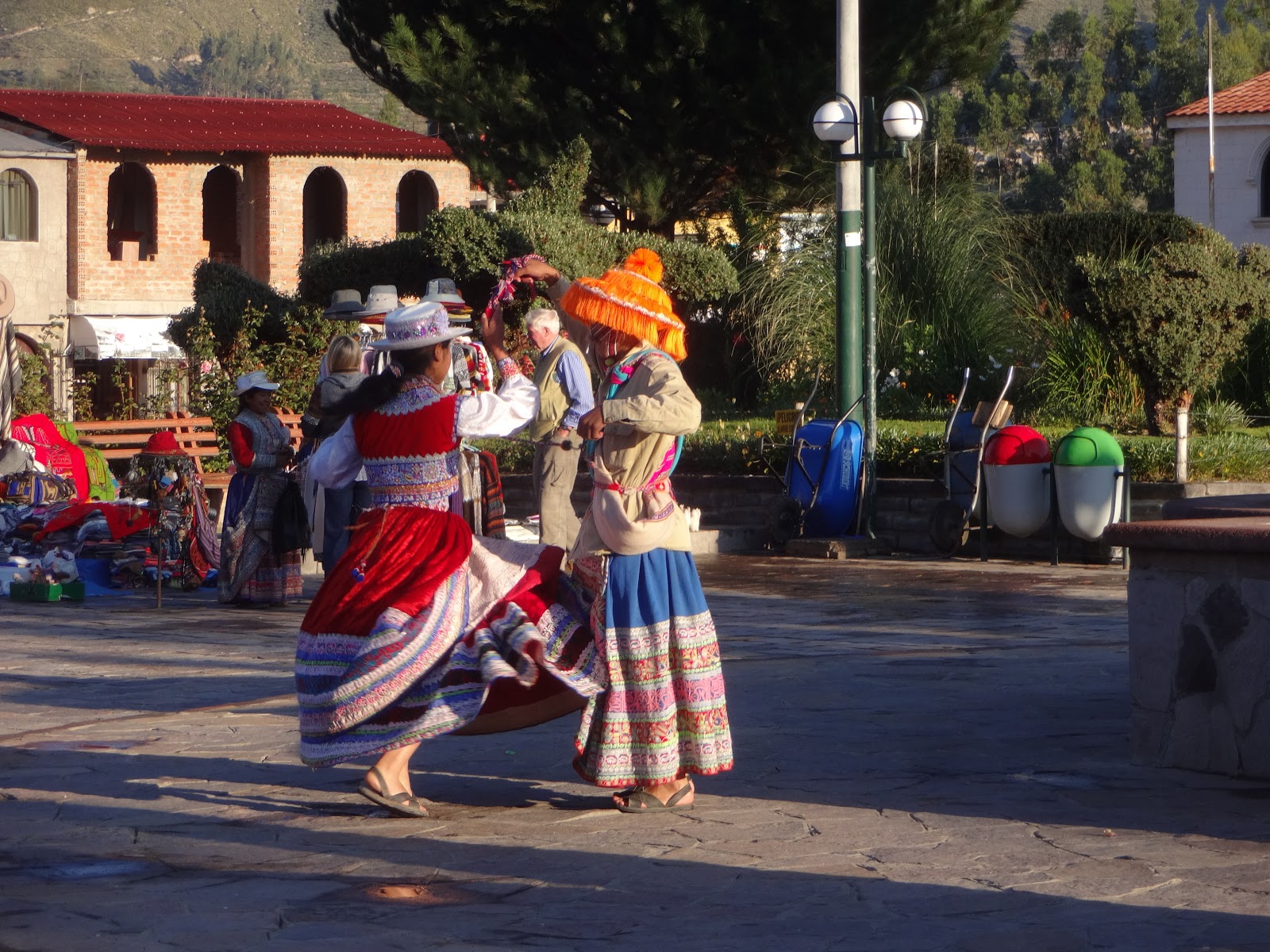
On Sunday, April 10th, we were up by 5 am and at breakfast in the lodge by 5:45. The air was cool but not quite cool enough for frost. In the lodge restaurant a good buffet breakfast, included in our tour package price, was laid out and we ate while gazing over a beautiful view across the valley on a sunny, clear morning. Our bus arrived at 6:30 and our first stop was the village square of Yanque where the local women were selling their wares and local teens in traditional costume performed a simple dance. It seemed a bit touristy.
Next we drove toward "El Cruz de Condor" or the Condor Cross. We stopped at various viewpoints along the way, including one where we saw our first condor. We had visited a rescue centre for injured condors last year in Otavalo, Ecuador so we had seen condors before but it was a new experience for many of our group.
As we approached the Cruz de Condor, we stopped about a kilometre away and walked along a trail to get there. There were lots of photo ops of the Colca Canyon and of condors soaring on the morning air currents. The Colca Canyon is twice as deep as the Grand Canyon and about 100 kilometres long. It is only slightly shallower than the neighbouring Cotahuasi Canyon, which is the deepest canyon on the Earth. The Colca River is shallow and rocky, so it seems an unlikely prospect for raft trips. Over the next mountain range that we could see to the east is the confirmed source of the Amazon.
When we left the Cruz de Condor about 9:20 am, we made several more photo op stops before we got to another small village where there were colourful statues around the square. These statues, representing different figures from folklore, are very popular in the little towns of the Colca Valley. One depicted a woman carrying a man wearing a mask on her back. We heard 2 different versions of the story behind it. In version one, the woman is carrying her drunk husband home from a wedding and he is wearing a mask to avoid embarrassment. In version two, the women are all dancing at some festival and the man is a joker whose job is to keep the crowd back. Sometimes he jumps on the ladies' backs as a joke. We could relate more to version one.
Around noon, we arrived back in the town of Chivay. The bus stopped at a buffet restaurant but we had ham sandwiches from the breakfast buffet, bananas bought from a vendor and water that we had brought so we ate lunch on a bench in the town square. Afterward, we met up with our group at the market near the square.
Even on Sunday, the market was fairly busy although some booths were closed. At every market we visit, there are lots of fruits, vegetables and grains that we don't recognize. Also at the time, we didn't know it was Election Day in Peru so more businesses than usual were closed.
That was our last tour event except for a washroom stop on the way back to Arequipa. It was a long, hair-raising ride. We were in the 2nd seat behind the driver. We never take the first seat because you see too many close calls. We also never sit in restaurants where you can see into the kitchen. Traveler survival tactics.
Finally, we got back to our hotel in Arequipa about 4 pm. It had been a great tour but we were tired. After a hot (thankfully) shower, we had lasagna, pizza and wine at the Inkara restaurant behind the cathedral and were in bed watching Netflix by 7:30 pm. Although we knew our knees wouldn't have liked a trek down into the Colca Canyon one day and back up the next, we still enjoyed a couple of short walks in the area and appreciating the scenery.
Next we drove toward "El Cruz de Condor" or the Condor Cross. We stopped at various viewpoints along the way, including one where we saw our first condor. We had visited a rescue centre for injured condors last year in Otavalo, Ecuador so we had seen condors before but it was a new experience for many of our group.
As we approached the Cruz de Condor, we stopped about a kilometre away and walked along a trail to get there. There were lots of photo ops of the Colca Canyon and of condors soaring on the morning air currents. The Colca Canyon is twice as deep as the Grand Canyon and about 100 kilometres long. It is only slightly shallower than the neighbouring Cotahuasi Canyon, which is the deepest canyon on the Earth. The Colca River is shallow and rocky, so it seems an unlikely prospect for raft trips. Over the next mountain range that we could see to the east is the confirmed source of the Amazon.
When we left the Cruz de Condor about 9:20 am, we made several more photo op stops before we got to another small village where there were colourful statues around the square. These statues, representing different figures from folklore, are very popular in the little towns of the Colca Valley. One depicted a woman carrying a man wearing a mask on her back. We heard 2 different versions of the story behind it. In version one, the woman is carrying her drunk husband home from a wedding and he is wearing a mask to avoid embarrassment. In version two, the women are all dancing at some festival and the man is a joker whose job is to keep the crowd back. Sometimes he jumps on the ladies' backs as a joke. We could relate more to version one.
Around noon, we arrived back in the town of Chivay. The bus stopped at a buffet restaurant but we had ham sandwiches from the breakfast buffet, bananas bought from a vendor and water that we had brought so we ate lunch on a bench in the town square. Afterward, we met up with our group at the market near the square.
Even on Sunday, the market was fairly busy although some booths were closed. At every market we visit, there are lots of fruits, vegetables and grains that we don't recognize. Also at the time, we didn't know it was Election Day in Peru so more businesses than usual were closed.
That was our last tour event except for a washroom stop on the way back to Arequipa. It was a long, hair-raising ride. We were in the 2nd seat behind the driver. We never take the first seat because you see too many close calls. We also never sit in restaurants where you can see into the kitchen. Traveler survival tactics.
Finally, we got back to our hotel in Arequipa about 4 pm. It had been a great tour but we were tired. After a hot (thankfully) shower, we had lasagna, pizza and wine at the Inkara restaurant behind the cathedral and were in bed watching Netflix by 7:30 pm. Although we knew our knees wouldn't have liked a trek down into the Colca Canyon one day and back up the next, we still enjoyed a couple of short walks in the area and appreciating the scenery.
Arequipa to Colca Valley
On Saturday morning, April 9th, we got up at 6 am, had a cold shower since the water heater was apparently turned off, finished packing and were in the dining room for breakfast by 7 am. When we checked out, we left my big pack in storage until we got back. We had already arranged for 3 more nights on our return Sunday night, at 100 soles per night ($40 CA).
Our Colca Canyon guide arrived promptly at 7:30 and we loaded into a nice 30 person or so bus. It took another 3/4 of an hour to pick up other tourists from different hotels. Traffic was busy as usual so it took almost another hour to get to the north edge of the city. There, we stopped at a little shop to use the washroom and to buy a package of coca leaves (3 soles) for altitude sickness. At the edge of town, we stopped to take pictures of the volcanos. Arequipa is surrounded by several volcanos, some of which are active. Volcanic eruptions, earthquakes and resulting landslides are facts of life here.
From Arequipa, we climbed for a couple of hours up to the high plateau. The 2 lane road is paved but very winding with tight curves and numerous crosses marking deadly accidents. There are lots of trucks and buses and everyone drives as fast as possible. In Arequipa it's very common to see taxis, especially, that have lots of dents from minor accidents.
As we got to higher elevation, our guide showed everyone how to chew coca leaves. You take 6 or 7 leaves, chew them for about 10 minutes, add a little bit of black gooey mint tasting stuff sold with the coca to make it taste less bitter and swallow the saliva. Eventually, your tongue starts to feel a little numb. You spit out the residue of the leaves and that's it. Any energizing effect is very mild but apparently it helps with the altitude.
As we entered a national wildlife preserve, we saw our first vicuñas. Vicuñas are about the size and shape of the white-tailed deer we have at home. Beautiful creatures.
We drove a long way on the high plateau. At one point we stopped where an alpaca herder and his 2 sons were tending their herd. We were allowed to mingle in with the alpacas, which were quite tame, and take pictures. Alpacas and llamas look very similar. The easy way to tell them apart is to look at the tails. Llama tails stick up and then down at the tip. Alpaca tails just hang down. As we left, we gave the 2 little boys of the herder a small tip. They appeared to be very poor but hardy people.
We climbed even higher until we reached the maximum elevation of the road: 4,910 metres (over 16,000 feet), where there was a small monument. Not much grows at that elevation. There is a low round plant that grows only from 4,500 to 5,500 metres. It looks like a moss on a rock but it's actually a plant that can grow to about 30 centimetres high. It's not fluffy but rather very hard. It grows only 1 millimetre per year and apparently lives for several thousand years.
By about 1:30 in the afternoon we reached the little town of Chivay, the biggest town in the Colca Valley. We dropped off most of our group there, while 8 of us went on to the Killawasi Lodge in the village of Yanque. Our friends Bob and Germaine had been here a few weeks ago and recommended it to us. It's in a very pastoral location near the Colca River. Our room was one of about 4 in a separate building. The room and bathroom were very clean and nicely decorated. We had our own little patio where we sat later for happy hour. Ever resourceful, we had brought water, wine and a couple of cans of beer with us.
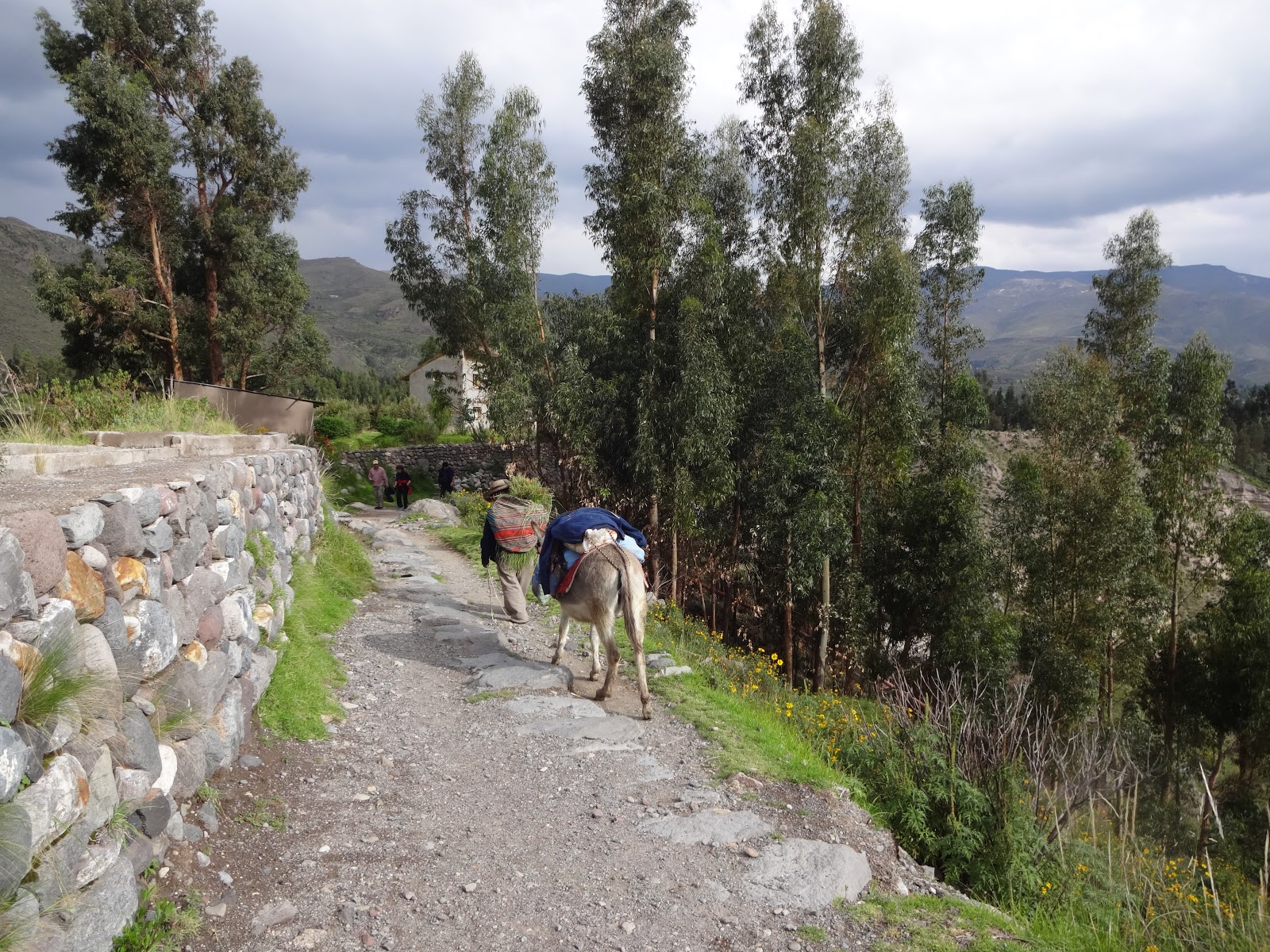
After a very late lunch of alpaca burgers (15 soles or $6 CA each) in the lodge restaurant, we went for a walk along the edge of the river gorge nearby. Despite the numbers of tourists visiting the Colca Canyon, life in Yanque seems to go on as it has for a long time. The first inhabitants here, long before the Incas or Spaniards, built terraced fields along the river to make flatter spots to farm. They used little caves in the cliffs (colcas) to store grain. They blocked the mouths of the little caves with stones to create granaries. On our Grand Canyon rafting trip a few years ago, we saw the same type of granaries created by the ancient native groups there. The colcas are no longer used but the terraced fields are still farmed. The farmers grow many different varieties of quinoa, potatoes and lots of other crops. They get only one harvest per year. The fields are passed down through inheritance for many generations.
Eventually, it was time for happy hour on our deck. In the lodge restaurant, there are always bowls of coca leaves and an urn of hot water to make coca tea. We started with some of that before enjoying some wine and beer. Eventually, we were driven inside by a thunderstorm and cold wind. We cranked up the electric heat in our room and were so tired and full from the alpaca burgers that we didn't even venture out for dinner. Another successful day.
Lima to Arequipa
Our last night in Lima, Wednesday, April 6th, was not completely successful. I couldn't figure out how to set my new watch; I had scratched my glasses so badly they were unusable; the streets were insanely busy while we tried to find a restaurant so we ended up eating nuggets and fries at KFC; Anita started seeing flashing lights that weren't there out of her right eye; and the cars on the street below our balcony beeped their horns incessantly.
However, the next morning looked a little brighter. I figured out my watch; I started using my old spare glasses (without one plastic nose piece); Anita's flashing lights stopped for the day at least and we had a good breakfast that was included with our hotel room. After packing up, we checked out and asked for a cab to the airport. The price we got was 60 soles ($24 CA) when we had only paid 40 soles on arrival. We argued but didn't want to chance a random cab on the street (not always safe) so we finally accepted. The desk clerk must have felt a little sheepish because when our cab arrived the price turned out to be 45 soles. The traffic in Lima is very heavy so it took about 3/4 of an hour to get to the airport but at least we arrived without problems for a reasonable price. Check-in was a breeze, our flight departed on time and we even got complimentary beer and a snack enroute. Once again our luggage arrived with us, which is always a pleasure when we see it coming around the carousel. Generally, we expect the worst.
For 30 soles, a taxi took us to our hotel, the Hostal Santa Marta, in the old part of town about 2 blocks from the Plaza de Armas, the main plaza in every city. It was raining during the drive and there was a lot of skidding on the steep cobblestone streets. That kept us alert. Our hotel is very clean, secure, pleasant and in an excellent location. Our first night we walked 2 1/2 blocks to a Turkish restaurant where we had a light meal. We were tired so we headed back to our room and on the way we bought some water and a box of the same wine Anita has been drinking in Ecuador for only 13 soles ($5.25 CA) for 1 litre. We were paying up to $8 US in Ecuador.
The next morning after our hotel breakfast, we set out to see some of the old part of town. We walked around the Plaza de Armas and into the big cathedral that stretches for the whole north side of the plaza. A priest was outside with just 2 folding chairs in a quiet spot, hearing confessions. He and the confessor sat in the open facing each other. The plaza has lots of trees and flowers and is very beautiful.
Arequipa is known as the white city because many of the buildings are built from white "Sillar" volcanic stone. A nice city to be in.
Eventually, we decided to visit the Monasterio de Santa Catalina, which is the Dominican convent, which covers 5 acres just northwest of the plaza. The convent was built in 1579, less than 40 years after the arrival of the Spaniards, and part of it is still in use by the nuns while the other part has been opened up to tourism. We spent about 2 hours walking around and saw lots of interesting artifacts. Everything was well labelled in several languages so there was no need for a guide. We learned that in the late 1600s the nuns were limited to having only one maid and a slave girl. The convent sustained itself mostly through dowries paid by the families of novices. The nuns took vows of silence, chastity and obedience and their main purpose was prayer to rescue souls in purgatory. Although they were cloistered for life, it didn't look like a particularly bad life for the times, perhaps except for the occasions when they felt they hadn't lived up to their vows and wore barbed wire undergarments or whipped themselves. Apparently that wasn't very often. The convent is like a city within a city with several streets and many buildings. There was a whole laundry area outside with many big scrubbing tubs into which water would run from a stone trough; there were numerous kitchens and of course numerous areas for quiet prayer. We could see el Misti, one of the local volcanos, from the roof. It was an interesting tour.
By the time we were done our feet were tired and we were hungry. For 28 soles, the Inkara restaurant behind the cathedral had lasagna and a glass of wine. We ate lunch outside at a table in the cobblestone alley between the walls of Sillar stone. Nice ambiance.
Back in our room we organized our gear for our trip early the next morning to the Colca Canyon. Eventually, we were ready and hungry again so we walked back down the street to Hatunpas, a restaurant that serves only varieties of potatoes covered with different toppings and sauces. For 35 soles total, including tip, we each had a plate of potatoes and shared a beer. It sounds awful but was surprisingly good.
However, the next morning looked a little brighter. I figured out my watch; I started using my old spare glasses (without one plastic nose piece); Anita's flashing lights stopped for the day at least and we had a good breakfast that was included with our hotel room. After packing up, we checked out and asked for a cab to the airport. The price we got was 60 soles ($24 CA) when we had only paid 40 soles on arrival. We argued but didn't want to chance a random cab on the street (not always safe) so we finally accepted. The desk clerk must have felt a little sheepish because when our cab arrived the price turned out to be 45 soles. The traffic in Lima is very heavy so it took about 3/4 of an hour to get to the airport but at least we arrived without problems for a reasonable price. Check-in was a breeze, our flight departed on time and we even got complimentary beer and a snack enroute. Once again our luggage arrived with us, which is always a pleasure when we see it coming around the carousel. Generally, we expect the worst.
For 30 soles, a taxi took us to our hotel, the Hostal Santa Marta, in the old part of town about 2 blocks from the Plaza de Armas, the main plaza in every city. It was raining during the drive and there was a lot of skidding on the steep cobblestone streets. That kept us alert. Our hotel is very clean, secure, pleasant and in an excellent location. Our first night we walked 2 1/2 blocks to a Turkish restaurant where we had a light meal. We were tired so we headed back to our room and on the way we bought some water and a box of the same wine Anita has been drinking in Ecuador for only 13 soles ($5.25 CA) for 1 litre. We were paying up to $8 US in Ecuador.
The next morning after our hotel breakfast, we set out to see some of the old part of town. We walked around the Plaza de Armas and into the big cathedral that stretches for the whole north side of the plaza. A priest was outside with just 2 folding chairs in a quiet spot, hearing confessions. He and the confessor sat in the open facing each other. The plaza has lots of trees and flowers and is very beautiful.
Arequipa is known as the white city because many of the buildings are built from white "Sillar" volcanic stone. A nice city to be in.
Eventually, we decided to visit the Monasterio de Santa Catalina, which is the Dominican convent, which covers 5 acres just northwest of the plaza. The convent was built in 1579, less than 40 years after the arrival of the Spaniards, and part of it is still in use by the nuns while the other part has been opened up to tourism. We spent about 2 hours walking around and saw lots of interesting artifacts. Everything was well labelled in several languages so there was no need for a guide. We learned that in the late 1600s the nuns were limited to having only one maid and a slave girl. The convent sustained itself mostly through dowries paid by the families of novices. The nuns took vows of silence, chastity and obedience and their main purpose was prayer to rescue souls in purgatory. Although they were cloistered for life, it didn't look like a particularly bad life for the times, perhaps except for the occasions when they felt they hadn't lived up to their vows and wore barbed wire undergarments or whipped themselves. Apparently that wasn't very often. The convent is like a city within a city with several streets and many buildings. There was a whole laundry area outside with many big scrubbing tubs into which water would run from a stone trough; there were numerous kitchens and of course numerous areas for quiet prayer. We could see el Misti, one of the local volcanos, from the roof. It was an interesting tour.
By the time we were done our feet were tired and we were hungry. For 28 soles, the Inkara restaurant behind the cathedral had lasagna and a glass of wine. We ate lunch outside at a table in the cobblestone alley between the walls of Sillar stone. Nice ambiance.
Back in our room we organized our gear for our trip early the next morning to the Colca Canyon. Eventually, we were ready and hungry again so we walked back down the street to Hatunpas, a restaurant that serves only varieties of potatoes covered with different toppings and sauces. For 35 soles total, including tip, we each had a plate of potatoes and shared a beer. It sounds awful but was surprisingly good.
Wednesday, April 6, 2016
Beach to the Big City
Wednesday, April 6th 2016 Lima Peru
On our last night in Montanita, we had to do the required pose by the surfboard "I love Montanita" sign right outside our hotel window. I tried to edit the sign with my arm.
The Peruvian flag just needs a maple leaf.
The monastery garden.
On our last night in Montanita, we had to do the required pose by the surfboard "I love Montanita" sign right outside our hotel window. I tried to edit the sign with my arm.
It was a relatively uneventful night after that except for the idiot on his phone in the hall outside our room who eventually had to be told to go away. Yesterday morning, we caught the 11 am Peninsula Libertad bus to Guayaquil. Three hours of air conditioned ride. From the bus station we quickly got a cab to the airport ($4 US) and got checked in. Security and customs were no problem so we had time to kill in a nice new air conditioned airport with good WIFI. Not that hard to take.
Our Avianca flight to Lima took 2 hours and the complimentary meal with wine was better than average. At customs in the Lima airport, they just asked a few simple questions and gave us a 60 day visa. Our luggage arrived fairly quickly so all was well. Trying to get a taxi to our hotel in the historic centre of Lima was a bit of a challenge. The first "authorized" company told us it would cost 45 dollars although I think she meant Peruvian soles. There's a big difference. She also said their company wouldn't drive us into the centre because of the protest going on and the horrible traffic. She suggested "Green Line" taxis just out the door. We tried them and it was no problem. For $13.80 US we got a cab right away that in about 1/2 hour had us at the Kamana Hotel.
The Kamana is about 15 years more faded than it's online pictures but it's okay. The congestion of downtown Lima was a bit of culture shock after 2 months in a little beach town but after a day of touring the sights we are getting used to it.
After our included breakfast this morning we started the self-guided walking tour of historic Lima as laid out in Lonely Planet. The Plaza San Martin starting point was only a few blocks from our hotel and there was a political rally of some kind getting set up. Next we walked up to the Plaza de Armas which on one side has the Cathedral of Lima containing Francisco Pizzaro's tomb and on another side the Presidential Palace. Then we walked a couple of blocks to the Church and Monastery of Santo Domingo. For 7 soles each (about $2.75 CA) we had close to an hour private tour with an English speaking guide, since we were the only ones signed up for that time slot. We saw lots of stuff about the 3 saints from Lima (Saint Rosa of Lima, Saint Martin de Porres and Saint John Macias - all saints Anita has taught her students about over the years), including their tombs, a library of 25,000 volumes dating back to the Spanish conquest and climbed high up into the bell tower. Great tour.
We finished just in time to catch the changing of the guard at the Presidential Palace. A brass band plays tunes like "El Condor Pasa" by Simon and Garfunkel while the goose-stepping guards change shifts. Meanwhile the police, with riot shields, helmets and shotguns loiter in the shade around each corner in case there's trouble. Security is tight.
We continued the tour past an excavated part of the old city wall and the Monasterio de San Francisco where there are 70,000 skeletons in the catacombs. Finally, just past the central market our tour ended at Chinatown. Just a few blocks away we found the Domus restaurant, highly recommended by Lonely Planet, where we had the set lunch for 20 soles each ($8) - juice, appetizer, chicken, rice and vegetables, and dessert in a nice cool dining room where we were surrounded by local business people.
We were getting hot and I needed a new watch so an air conditioned department store provided the answer. Now I finally know the time again almost 2 months after my watch died. We've included a few pictures of our day. The last one is a shot of the yellow vested money changers who seem to be all over downtown. Tonight we'll get a light supper and take it easy. Fun day.
The Peruvian flag just needs a maple leaf.
The monastery garden.
Sunday, April 3, 2016
Canoa to Montanita
April 3rd, 2016 Montanita Ecuador
On Friday, we got up at 6, which is not unusual, had breakfast, packed up and walked down our road to the gas station for the last time. We were sorry to leave our apartment in Canoa but after beach bumming for over 1 1/2 months, it was time to move on. We were hoping to catch a Coactur bus to Jipijapa and then a Manglaralto bus to Montanita. There are many different bus companies in Ecuador on many routes. Some buses are comfortable and air conditioned while others are hot, dirty and have broken seats.
We let one bus go by but were persuaded to get on the 2nd bus which we were told was going to Jipijapa. As soon as we got on, we realized we didn't want to travel several hours on that bus, for the reasons mentioned above. We paid $1 to go to San Vicente, where we got off to find a better bus. The San Vicente bus terminal is actually a dirt parking lot behind a big market. The driver and flight attendant of our original bus convinced us to stay so we left our packs in the storage compartment underneath while we waited to leave again. Just as we were about to go, an air conditioned Coactur bus pulled in and they told us they were going to Jipijapa. I ran for our bags while our original bus was backing up. No-one would help me because they knew we were going to a rival company. I managed to get the compartment open, our bags out and the compartment closed again. However, I got pretty dirty since it had rained during the night and everything was covered in mud.
We paid $5 each for the Coactur bus which took us for several hours to Portoviejo. When I asked if we were going on to Jipijapa, as promised, they told us to grab our bags and took us to a crappy bus which apparently would go directly to Montanita.
We had been in the middle of eating our packed lunch so it was quite a scene but once again we were on the move for another $5 each. It took a long hot afternoon to get to Montanita but finally we arrived. We walked down to the Malecon and to the Tabuba Hotel where we thought we had a reservation although when we booked we had received no confirmation. That's not unusual here. Luckily, everything was in order. We have a nice ocean view "matrimonial room" right on the little Malecon, about 7 metres from the breakwater with walkway on top and about 12 metres from the ocean at high tide. Great location. For $50 US per night, we have a fridge, air conditioning and get a breakfast of coffee, tea, juice, scrambled eggs, toast and fruit. The Internet here is spotty but that's not unusual.
Montanita is never boring. Yesterday morning while we looked out our window before breakfast we saw a man and a woman in a long dress stumble out into the surf laughing and kissing, obviously still drunk from the night before. Shortly after that we saw a school of about 8 or 10 dolphins swim by just beyond the surf. This morning we saw a drunk start walking out to sea. His friends had to go after him and literally carry him away. The surf is so loud we don't hear much of the partying that goes on at night, especially Saturday night. However, last night we could hear the bass and drums of a live band playing in a little bar nearby. They quit at 6 am.
Yesterday morning we walked about 1 km to the point where the best waves come in. There was a surfing competition so we watched that for awhile. Great surfers. It reminded us of all the whitewater kayaking competitions we attended over the years when Zack, Dylan and Annie were competing.
About a week ago in Canoa, while we were walking on the beach, a wasp or something on the sand stung Anita's middle toe on her left foot. It was sore and swollen for a few days but was finally healing yesterday. Unfortunately, yesterday morning a wasp or something on the sand stung the bottom of her right foot. Now her right foot is red, swollen and painful to walk on. Rotten luck!
This morning while Anita recuperated in our room, I walked back up to the point to see today's surfing competition. I watched some longboard surfers doing tricks like walking up to the very front tip of their board ("hanging five" or "hanging ten"). One guy stood straight up for a few seconds with his arms outstretched and all ten toes gripping the front of his board, before he had to retreat to stay on the wave. Some of these competitive surfers are really good.
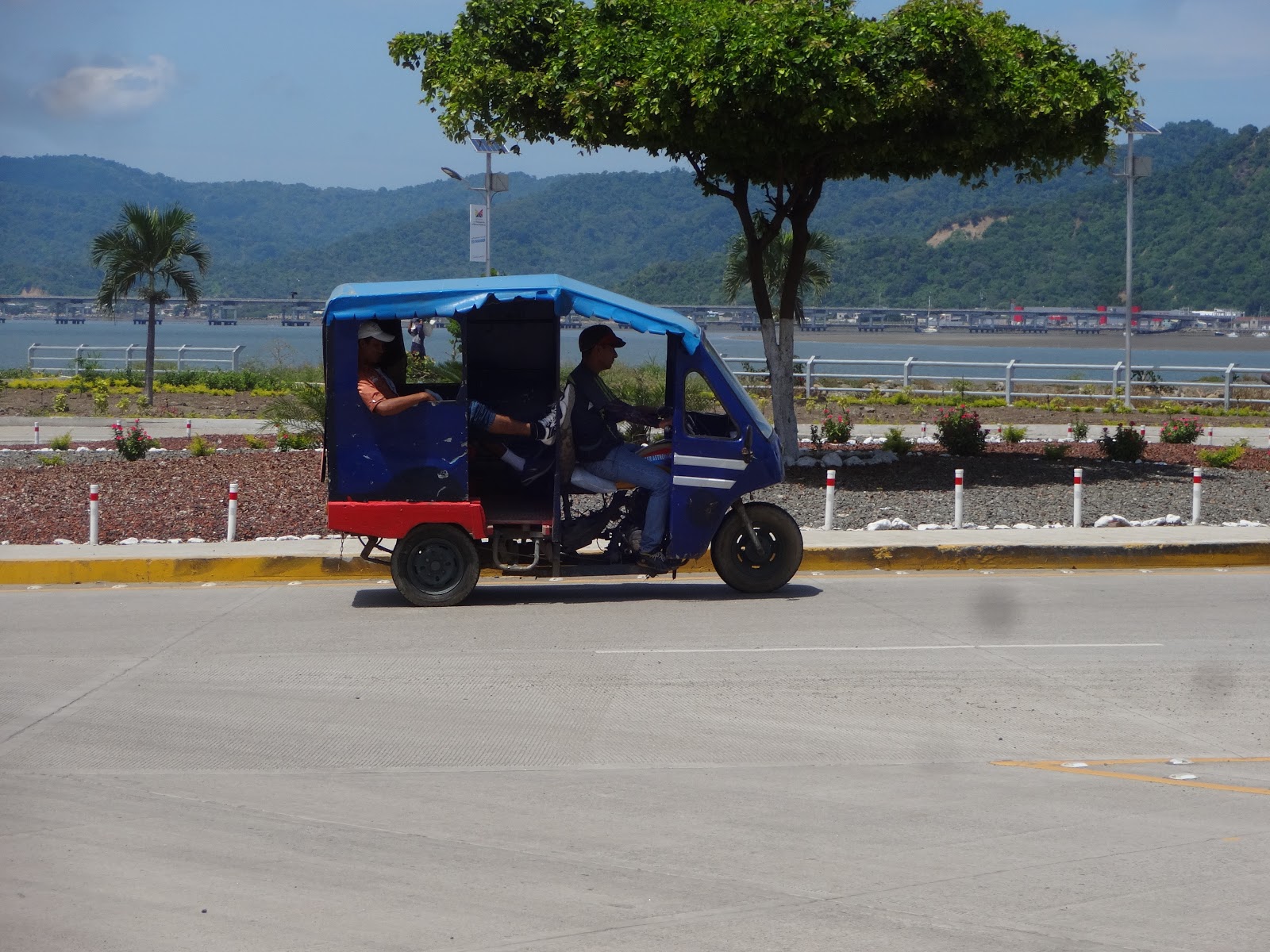
I have attached some pictures of moto-taxis (or tuk-tuks as they're called in southeast Asia), our friend and trivia partner Elizabeth who owns the Coco Loco hostel in Canoa,truck buses, the San Vicente bus station and food vendors, and the San Vicente bus station washroom. Anita said the women's was okay but the men's would need a flame thrower to sanitize it. We also have some pictures from our room.
On Friday, we got up at 6, which is not unusual, had breakfast, packed up and walked down our road to the gas station for the last time. We were sorry to leave our apartment in Canoa but after beach bumming for over 1 1/2 months, it was time to move on. We were hoping to catch a Coactur bus to Jipijapa and then a Manglaralto bus to Montanita. There are many different bus companies in Ecuador on many routes. Some buses are comfortable and air conditioned while others are hot, dirty and have broken seats.
We let one bus go by but were persuaded to get on the 2nd bus which we were told was going to Jipijapa. As soon as we got on, we realized we didn't want to travel several hours on that bus, for the reasons mentioned above. We paid $1 to go to San Vicente, where we got off to find a better bus. The San Vicente bus terminal is actually a dirt parking lot behind a big market. The driver and flight attendant of our original bus convinced us to stay so we left our packs in the storage compartment underneath while we waited to leave again. Just as we were about to go, an air conditioned Coactur bus pulled in and they told us they were going to Jipijapa. I ran for our bags while our original bus was backing up. No-one would help me because they knew we were going to a rival company. I managed to get the compartment open, our bags out and the compartment closed again. However, I got pretty dirty since it had rained during the night and everything was covered in mud.
We paid $5 each for the Coactur bus which took us for several hours to Portoviejo. When I asked if we were going on to Jipijapa, as promised, they told us to grab our bags and took us to a crappy bus which apparently would go directly to Montanita.
We had been in the middle of eating our packed lunch so it was quite a scene but once again we were on the move for another $5 each. It took a long hot afternoon to get to Montanita but finally we arrived. We walked down to the Malecon and to the Tabuba Hotel where we thought we had a reservation although when we booked we had received no confirmation. That's not unusual here. Luckily, everything was in order. We have a nice ocean view "matrimonial room" right on the little Malecon, about 7 metres from the breakwater with walkway on top and about 12 metres from the ocean at high tide. Great location. For $50 US per night, we have a fridge, air conditioning and get a breakfast of coffee, tea, juice, scrambled eggs, toast and fruit. The Internet here is spotty but that's not unusual.
Montanita is never boring. Yesterday morning while we looked out our window before breakfast we saw a man and a woman in a long dress stumble out into the surf laughing and kissing, obviously still drunk from the night before. Shortly after that we saw a school of about 8 or 10 dolphins swim by just beyond the surf. This morning we saw a drunk start walking out to sea. His friends had to go after him and literally carry him away. The surf is so loud we don't hear much of the partying that goes on at night, especially Saturday night. However, last night we could hear the bass and drums of a live band playing in a little bar nearby. They quit at 6 am.
Yesterday morning we walked about 1 km to the point where the best waves come in. There was a surfing competition so we watched that for awhile. Great surfers. It reminded us of all the whitewater kayaking competitions we attended over the years when Zack, Dylan and Annie were competing.
About a week ago in Canoa, while we were walking on the beach, a wasp or something on the sand stung Anita's middle toe on her left foot. It was sore and swollen for a few days but was finally healing yesterday. Unfortunately, yesterday morning a wasp or something on the sand stung the bottom of her right foot. Now her right foot is red, swollen and painful to walk on. Rotten luck!
This morning while Anita recuperated in our room, I walked back up to the point to see today's surfing competition. I watched some longboard surfers doing tricks like walking up to the very front tip of their board ("hanging five" or "hanging ten"). One guy stood straight up for a few seconds with his arms outstretched and all ten toes gripping the front of his board, before he had to retreat to stay on the wave. Some of these competitive surfers are really good.
I have attached some pictures of moto-taxis (or tuk-tuks as they're called in southeast Asia), our friend and trivia partner Elizabeth who owns the Coco Loco hostel in Canoa,truck buses, the San Vicente bus station and food vendors, and the San Vicente bus station washroom. Anita said the women's was okay but the men's would need a flame thrower to sanitize it. We also have some pictures from our room.
Subscribe to:
Posts (Atom)