Wednesday, November 6, 2013

Lesser Three Gorges

Friday, October 18, 2013
We continued our cruise up the Yangtze through the night, docking early in the morning opposite the Lesser Three Gorges, a tributary stream.
 Our room on the Century Diamond is very spacious and comfortable. The service is 5 star. Every time we leave the room, someone comes in and makes the bed, fluffs the pillows or changes the towels.
 We disembarked onto smaller boats to take an excursion up the Lesser Three Gorges tributary stream.
 We traveled for about 40 minutes through the narrow winding gorge.
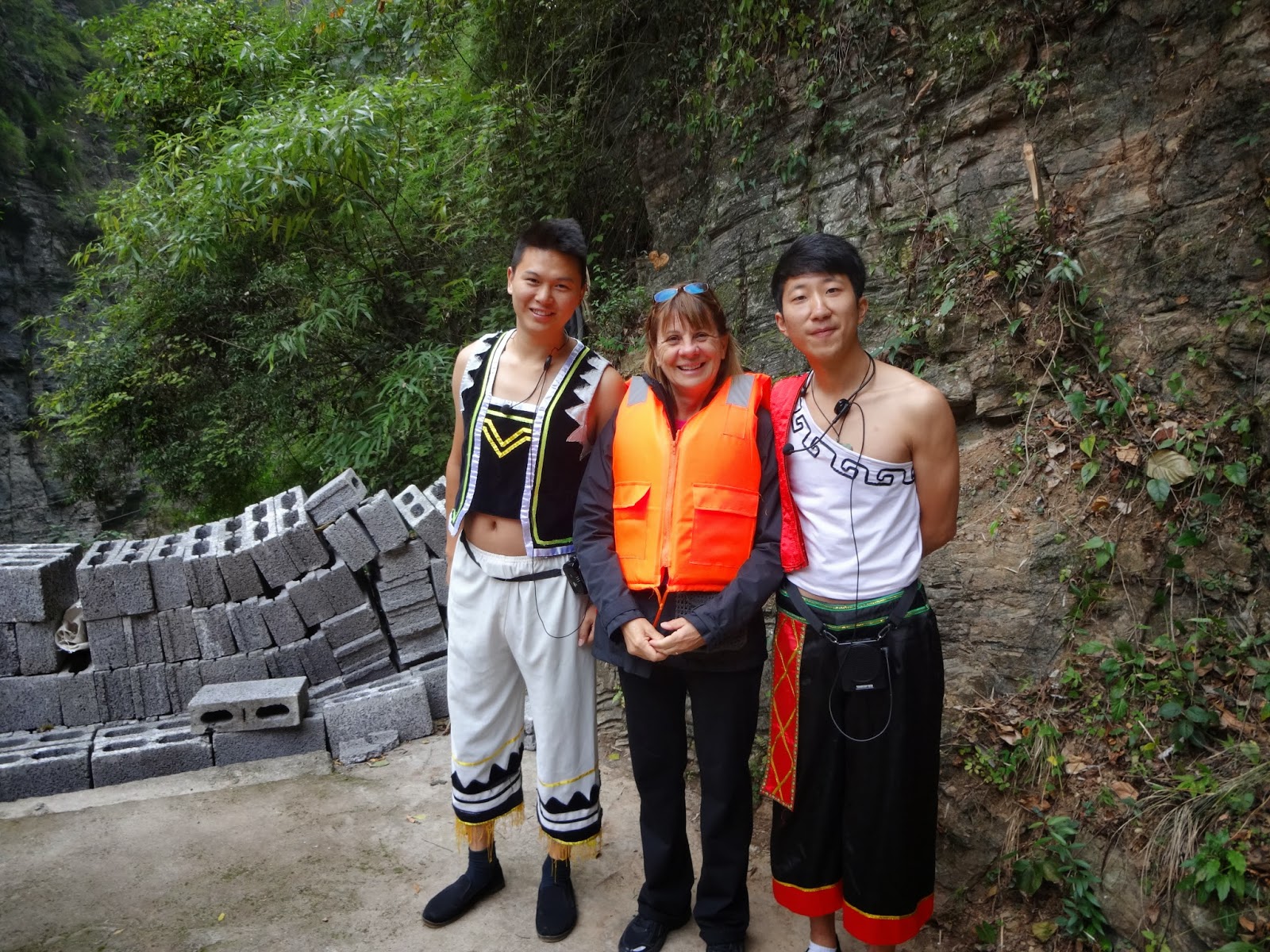
 At the end of the navigable stream, there was a local presentation for the tourists. A couple of the fellows, attracted to Anita's revealing outfit, pleaded to get their pictures taken with her.
 Then the local ladies asked to pose with both of us.
Anita taught both tourists and locals how to do the "Water Safety is Always Important" dance, requiring lifejackets for tourists but not for the daredevil locals.
 Finally, we traveled back downstream to the cruise boat.
 Whenever we return to the big boat, there are always hot towels and green tea waiting for us.
 Staff always help people back along the ramps to the ship.
 This is the main foyer of the Century Diamond, showing different deck levels.
 This is typical housing and agriculture along the river.
 There is lots of commercial shipping along the river but no pleasure craft like we'd see in Canada.
We had passed the Xiling Gorge at the dam, the Wu Gorge above the dam and then finally the Qutang Gorge in the late afternoon. After the 3 Gorges, sometimes as we traveled through the night we could see the lights of major cities.

Three Gorges Dam

Thursday, October 17, 2013
 Through the morning, we traveled up the Yangtze River below the Three Gorges Dam. Our boat is the "Century Diamond", designed to be a Yangtze River cruise ship carrying about 260 passengers plus crew. Each room is adequately sized with ensuite bathroom and glass doors out to a private balcony. There are 5 or 6 decks, a big buffet restaurant, an a la carte restaurant and a big bar.
 As we traveled up the river, there were a number of floating docks, villages and walkways up the steep riverbank.
 It's quite mountainous terrain.
 It was a little cool and cloudy but we still managed a photo op on the observation deck.
 We docked below the 3 Gorges Dam and took a bus up to the dam site. The dam is in the background behind Anita. This whole site is unbelievably huge.
Facing the other way from a different vantage point, the 5 stage ship lock is behind us.
 There are always ships passing through the locks. Everything about the 3 Gorges project is on a massive scale. There are numerous turbines for power generation, a 400 sq km (I think) reservoir behind the dam, big locks and a big ship elevator that's still under construction. This project generates a lot of power, facilitates navigation and prevents flooding but it also displaced over a million people who had to move to higher ground and the environmental consequences are still being debated. Anyway, it's very impressive to see.
 After we returned to the boat, it entered the locks. This is a view inside the lock from our balcony. It took several hours through the evening to get through the 5 locks.
We all dressed up for the Captain's Welcome Party. We're missing Ram and Nazeera in this photo but otherwise it's our regular dinner group of Kathy, Mary, Anita, me, Frank and Kevin.
Early in the trip, Frank had left an old coat that he wanted to get rid of in his hotel room. As we got on our bus, the hotel staff rushed out to give it back to him, thinking he had forgotten it. Later he tried to leave it a couple of other places but it was always returned to him and it was hard to explain that he didn't want it. Finally, one morning he left it at the hotel desk and explained that he didn't want it. When Anita saw this, she surreptitiously picked it up, put it in her suitcase and carried it for over a week. Finally, at the welcoming reception, with much difficulty in translation, she convinced the captain to present it to Frank, who had thought it was long gone. Everyone in our group but Frank knew about this all along. Anyway, Frank, although quite surprised, accepted it gracefully. Later that night as we passed through the locks, he stepped out on his balcony and dropped the coat onto the deck of a ship beside us.
As far as we know, the coat is still somewhere in China.

Shanghai to Yichang

Tuesday October 15, 2013
This morning we visited the Shanghai Museum.
 There were some interesting artifacts and we were almost done our wandering when we heard someone say, "Bill and Anita?". We turned around and it was Janet Dunn from Combermere. She had no idea we were in China and we had no idea she was touring there. Small world. Even a disembodied hand is pointing at us.
 At lunch we went to a Mongolian grill restaurant where Anita entertained the staff by juggling plates of food. At least she wasn't on a table this time. After lunch we visited a rug and clothing factory specializing in cashmere items.
 Later in the afternoon we wandered around in the old part of Shanghai. There were lots of interesting old buildings. We bought T-shirts but didn't have the patience to negotiate properly, although we've had lots of experience doing that. We paid a little more than we should have but at least it got us back into the reality of negotiation in Asia.
After dinner we went to an Acrobatics Show. We couldn't take any pictures but this was another highlight of the trip. The acrobats performed routines reminiscent of Cirque de Soleil. Although most of the show was quite low tech, at the end, 2 motorcyclists entered a big steel cage globe and raced around each other. Then they stopped, assistants opened a trap door with a ramp, and another motorcyclist joined them for a few minutes of racing around in circles and spirals. Then a 3rd joined, then a 4th, 5th, 6th, 7th, 8th and I think 9th. By the last few we were saying, "Oh no", as each one entered. It was an exciting finale.
Wednesday, October 16, 2013
On Wednesday morning, we reluctantly checked out of our hotel. It was so nice we didn't want to leave. We traveled back out to the Shanghai airport and flew on another modern jet to Wuhan, another fair sized Chinese city of which we had been previously unaware. After landing at the beautiful, modern Wuhan airport (again, typical), we traveled 4 hours by bus to Yichang.
On the way we had a short rest stop at a big service station / convenience store along the highway. This was a more typical Chinese washroom: steel trough for the men, squat toilets for the women, no water, no soap, no towels. In the store, there was a boiling water dispenser for making instant noodles and tea, so many of us used that to wash our hands. Hot.
After dinner in a restaurant, in the evening we embarked on our cruise ship at Yichang. By this point in the trip, everyone was tired and many people (including both of us) had the "Sinorama cough". In such close quarters all the time, any virus spreads rapidly.
Our cabin looked great and we remained moored at the dock for most of the night. We were looking forward to our Yangtze river cruise for 4 nights.

Tuesday, November 5, 2013

Shanghai waterfront

Monday, October 14, 2013
Today we traveled by bus back to Shanghai.
 Our first stop was along the Bund, the historical downtown financial centre of China. The bull is similar to the Wall Street Bull. There is a levee and walkway along the river to prevent flooding.
 Looking across the river from the walkway, we could see the more modern side of the financial centre,  built within the last 20 years or so.
 Anita and I are posing with our national guide, who used the English name "Mark". Mark lives in Beijing and speaks quite good "Chinglish". That is, he has difficulty with some words or phrases but is very good at understanding and being understood. He traveled with us for the whole 23 days and looked after every detail. Very pleasant, patient and organized, he was a fantastic guide.
 We stopped at a silk workshop where we all took a turn helping the workers stretch some pure silk to form the inner layers of a silk duvet. Many of the group purchased silk bedding and other items.
 In the afternoon we took a boat cruise along the Huangpu River through the heart of downtown.
Although I'm not a real fan of cities, Shanghai has the most fantastic skyline I've ever seen. There are huge skyscrapers with unique designs, including the 118 storey (I think) "bottle opener". It's owned by a Japanese financial corporation and was originally designed to have a round hole through the upper floors to let the wind pass through. However, Chinese authorities felt that design looked too much like the Japanese flag and demanded a change. There is still a great deal of animosity in China toward the Japanese. The Japanese invasion of China during WWII has not been forgotten.
 In the late afternoon, we wandered through the pedestrian mall of Nanjing Road where there are many large stores and high end boutiques.

In the evening we checked into the Wyndham Bund East Shanghai Hotel where Anita amused herself by playing with the remotes for the motorized window blinds and the TV in the bathroom.
Very nice room.

Zhengzhou to Suzhou

Sunday, October 13, 2013
This morning we flew to the Shanghai airport and then traveled by bus for about an hour to the city of Suzhou. The local guide told us on the way that Suzhou was just a small city - only about 7 million people. The total population of Canada is approximately equal to the combined population of Shanghai and Suzhou. I believe there are over 100 cities exceeding 1 million people in China and most of us have never heard of them.
 We had some free time in the afternoon to wander through the old part of the city which has a number of canals for transport.
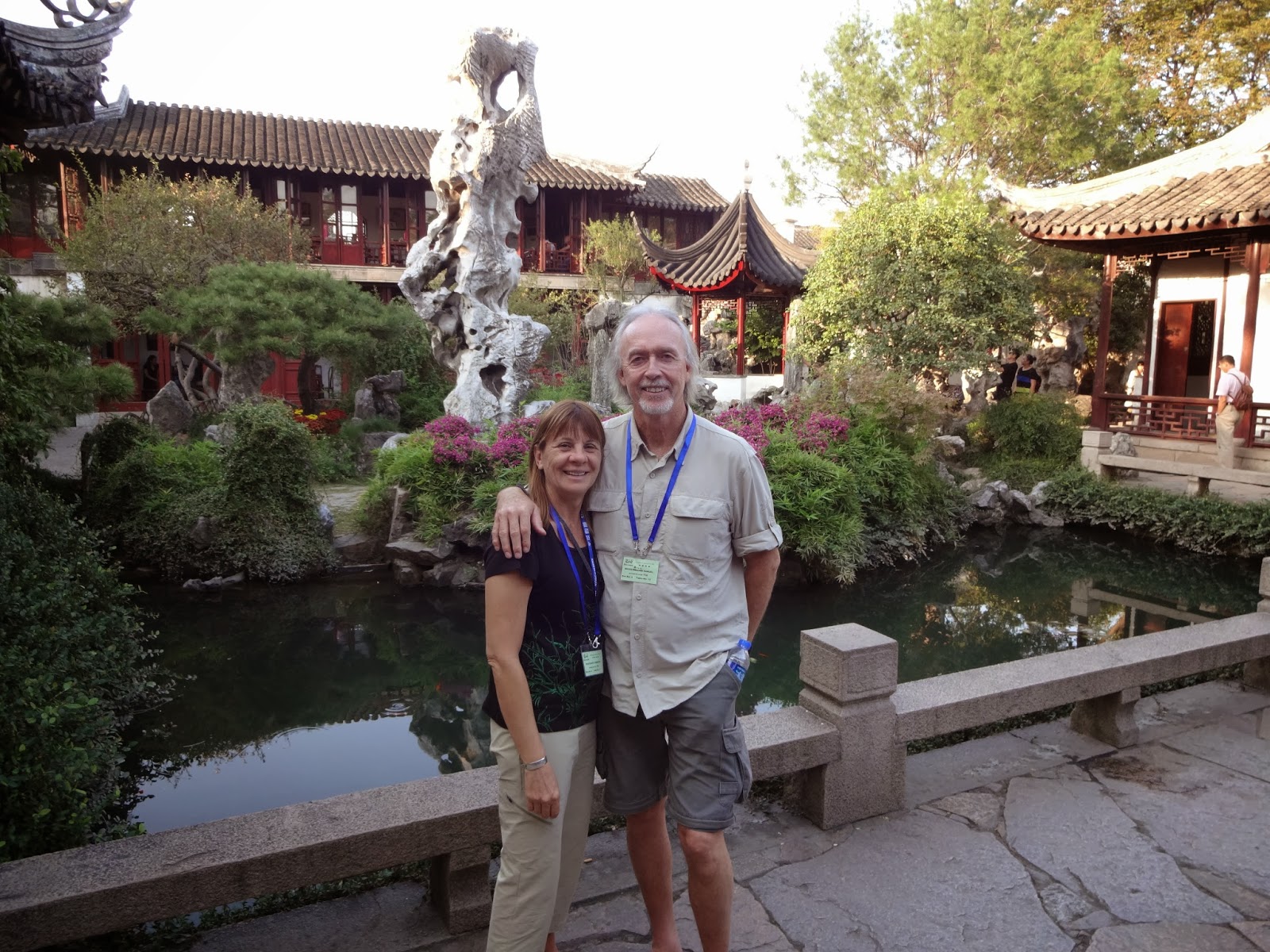
 Later in the afternoon, we walked through a doorway off a busy downtown street into the Liu Garden. Historically, wealthy Chinese families would create their own tranquil gardens in the middle of the city. There is no indication from the street that this complex of gardens, ponds and small buildings for relaxation exists. However, it takes up an area of about a normal city block.
 There are different gardens and sculptures or rocks placed throughout.
This is part of the lobby of the Suzhou Gusu Jinjiang Hotel where we stayed. Sinorama Holidays promised 5 star hotels and they delivered. This isn't the nicest hotel we stayed in; it's just a typical example. We likely could never have afforded to stay in such hotels if we were traveling on our own. The only complaint anyone had about the hotels is that often we didn't have enough time to enjoy them.

Monday, November 4, 2013

Longmen Caves and Shaolin Temple

Saturday, October 12, 2013
This morning we left Xian on the high speed train to Luoyang.
 The high speed train stations look like new airports.
 The train was very comfortable and very fast - as good or better than the best trains in Europe.
 At the Longmen Caves there are 97,000 Buddha images carved into the cliffs.
 Most of the images are very small but a few are very large.
We had walked along the cliffs to go right up to all the grottoes and images but boated back along the river for a long range view.
After lunch, we traveled for an hour or two by bus to Song Shan, the town near the famous Shaolin Buddhist Temple founded in the 5th century. The mountainous terrain and bamboo forest were dangerous due to wild animals and bandits, so the monks developed and trained in kung fu, a martial art  from which many other martial arts are derived. Because of the influence of the monks, there are now several large kung fu training schools. We attended a demonstration at one of the schools which has 10,000 boarding students ages 4 to 20.
 Pushing on the point of a spear with your throat requires great focus and control.
 Many of the students are very young and very flexible.
 The students are trained in unarmed defence as well as the use of a number of different weapons.
 I was a little old to sign up but at least I got my picture taken.
As we left the school, the huge yards were full of classes practising. Parents pay several thousand dollars per year to send their children to this school. It's very spartan and disciplined. Upon graduation, the students are kung fu masters. Most just get regular jobs but some open their own training schools while others work in security or even in the movies.


 After the kung fu demonstration, we traveled a few km to the Shaolin Temple, which is a fairly big complex of buildings in a bamboo forest, surrounded by mountains.
Although it's a major tourist attraction, it is still also a working monastery.
After the monastery tour, we went to a restaurant for a "monk's" vegetarian dinner and then traveled by bus to Zhengzhou to our hotel. Another full day.